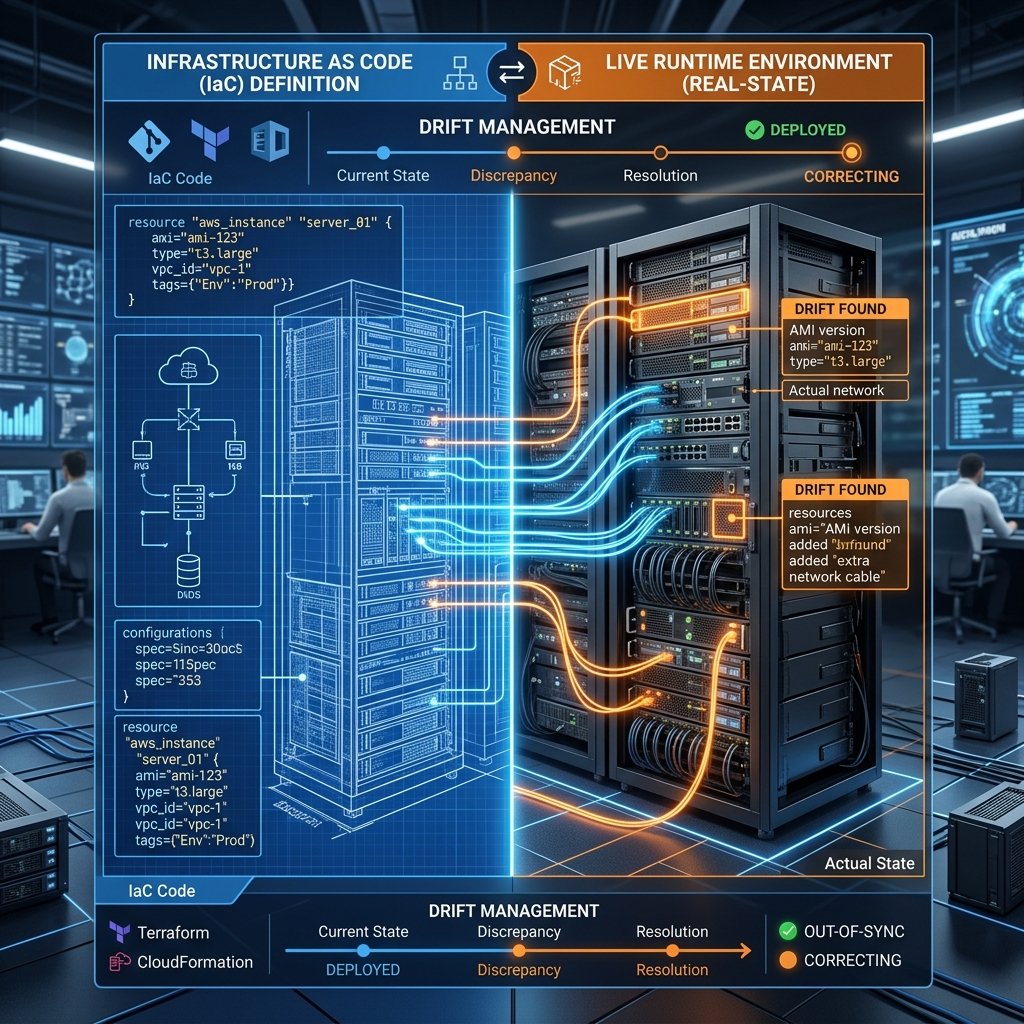
Configuration Drift Management: Maintaining Compliance in High-Velocity DevOps
"A technical guide for architects on identifying and remediating configuration drift in hybrid cloud environments. Learn how to maintain the 'Source of Truth' using IaC, GitOps, and automated governance."
Configuration Drift Management: Maintaining Compliance in High-Velocity DevOps
In the ideal world of a Lead Digital Architect, every resource in the cloud matches its definition in Infrastructure as Code (IaC). However, the reality of enterprise operations is "Configuration Drift." This occurs when manual "hotfixes" are made in the Azure portal, or when automated processes change settings without updating the code. Over time, this drift creates security vulnerabilities, breaks deployment pipelines, and erodes your Infrastructure Management (IMS) standards.
"Configuration Drift is the silent killer of architectural integrity. It is the gap between what you think you have deployed and what is actually running in production." — TAPOSYS Architectural Insight
The Strategy for Drift Remediation
Managing drift requires moving beyond "periodic audits" to a continuous, automated feedback loop between your live environment and your source of truth.
1. Establishing the Immutable Source of Truth
The first step is to mandate that all changes go through a version-controlled repository. If it's not in Git, it doesn't exist.1. Infrastructure as Code (IaC): Use Terraform or Bicep to define your entire environment—from VNets to the Digital Core (SAP) components. 2. GitOps Workflows: Implement tools like Flux or ArgoCD (or standard GitHub Actions) that treat your Git repository as the desired state. Any change to the code triggers an automatic update to the infrastructure. 3. Strict Portal Permissions: Limit "Contributor" and "Owner" rights in the Azure portal. Most engineers should have "Reader" access, with changes only possible via the service principal used by the CI/CD pipeline.
2. Automated Detection and Alerting
You cannot fix what you do not know has changed. You need a system that "shouts" when the live environment deviates from the code.1. Terraform Plan Audits: Run scheduled `terraform plan` jobs in your pipeline. If the plan shows any changes are needed to reach the desired state, it means drift has occurred. 2. Azure Policy for Drift: Use "AuditIfNotExists" or "Deny" policies to identify resources that have been manually modified in a way that violates your architectural standards. 3. Real-Time Alerts: Integrate drift detection with your AIOps platform to notify architects immediately when a critical security setting (like an NSG rule) is manually altered.
3. Implementing the "Reconciliation Loop"
Once drift is detected, the system should ideally fix itself. This is the hallmark of a mature DevOps organisation.1. Auto-Remediation: Configure your GitOps pipelines to automatically overwrite manual changes and restore the infrastructure to its versioned state. 2. Immutability over Repair: Instead of trying to "patch" a drifted server, the architecture should trigger a redeployment of the resource from the original, clean image/code. 3. Manual Override Exceptions: Define a strict "Emergency Break-Glass" process for manual changes. Every manual change must be followed by a "Refactor" ticket to bring the IaC back in sync with the portal.
"A resilient architecture is not one that never drifts; it is one that can automatically find its way back home to the code."
Executive Drift Management Checklist
The TAPOSYS Perspective: Engineering Consistency at Scale
At TAPOSYS Global IT Solutions LLP, we believe that consistency is the foundation of security and performance. Our Infrastructure Management (IMS) methodology focuses on the "A-Z" of consistency—from initial IaC design to the implementation of complex GitOps reconciliation loops. We help enterprises eliminate the risk of configuration drift, ensuring that your Cloud Engineering environment remains as secure and compliant as the day it was built.Key Takeaway
Configuration Drift Management is a critical operational discipline. By enforcing an immutable source of truth, implementing automated detection, and committing to self-healing reconciliation loops, organisations can maintain architectural integrity and security in even the most high-velocity DevOps environments.--- Struggling with infrastructure inconsistency? Explore our DevOps and Infrastructure Management services at TAPOSYS Global.

The TAPOSYS Perspective
Our architecture-first methodology ensures that every digital transformation initiative is rooted in absolute scalability and long-term security. We don't just build systems; we engineer future-proof legacies.