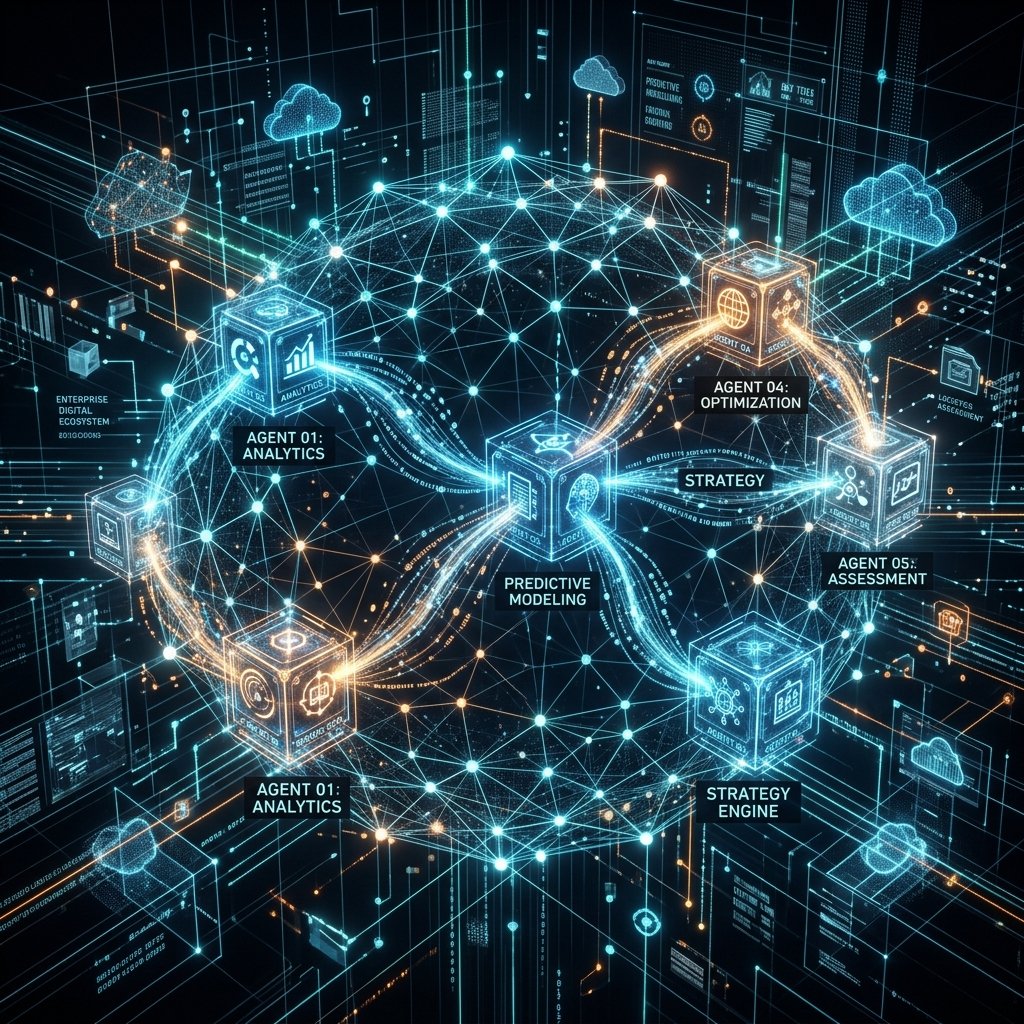
Agentic AI Frameworks: Developing Autonomous Agents for Business Process Automation
"An exploration into the next frontier of AI Engineering: Agentic AI. Learn how to architect autonomous agents that can plan, reason, and execute complex business workflows independently."
Agentic AI Frameworks: Developing Autonomous Agents for Business Process Automation
The first wave of Generative AI was about chatbots and content generation. The second wave, which we are entering now, is about Agentic AI. For the Chief Content Officer and the Lead Digital Architect, the goal has shifted from "AI that talks" to "AI that does." An Autonomous Agent is a system that uses a Large Language Model (LLM) as its brain to reason, plan, and execute multi-step tasks by interacting with external tools and APIs. This is the ultimate evolution of AI Engineering.
"A chatbot answers a question; an Agent solves a problem. The transition to agentic frameworks is the moment AI moves from being a creative assistant to being a digital employee." — TAPOSYS Architectural Insight
The Anatomy of an Autonomous Agent
Building an agentic system requires more than just a prompt; it requires a sophisticated architectural framework that handles memory, tool integration, and iterative reasoning.
1. The Reasoning Engine (The Brain)
At the core of the agent is an LLM (like GPT-4o or Claude 3.5). The agent doesn't just predict the next word; it uses frameworks like ReAct (Reason + Act) to decompose a high-level goal into a series of smaller, executable steps.1. Objective Decomposition: The agent takes a prompt like "Reconcile this month's cloud spend against the project budget" and identifies the need to access billing APIs, spreadsheets, and historical data. 2. Self-Correction: If an agent encounters an error (e.g., an API returns a 404), it reasons about the failure and attempts an alternative path rather than simply stopping. 3. Persona Consistency: Agents must be designed with specific system prompts that define their role, constraints, and professional tone, ensuring they behave as reliable enterprise representatives.
2. Tool Use and Action Execution (The Hands)
An agent is powerless if it cannot interact with the world. Through Function Calling, we give agents "tools" to interact with your Digital Core and infrastructure.1. API Connectors: Provide the agent with secure access to your ERP (SAP), Cloud Billing (Azure), or CRM (Salesforce) via standardized REST APIs. 2. Python Code Execution: Enable the agent to write and execute its own scripts for complex data analysis, mathematical calculations, or file processing. 3. Search and Retrieval: Integrate RAG (Retrieval-Augmented Generation) so the agent can search internal documentation and knowledge bases to ground its actions in company-specific facts.
3. Memory and State Management
For an agent to handle long-running business processes, it must remember what it has done.1. Short-Term Memory: This is the context window of the current conversation, allowing the agent to follow a specific line of reasoning. 2. Long-Term Memory: Utilise Vector Databases (like Pinecone or Azure AI Search) to store past interactions and outcomes, allowing the agent to "learn" from previous successes and failures. 3. Persistence: Ensure that if an agentic workflow is interrupted, it can resume from its last known state without losing progress.
"The magic of Agentic AI isn't in the LLM's knowledge; it's in the agent's ability to navigate the gap between a human's intent and a machine's execution."
Executive Agentic AI Checklist
The TAPOSYS Perspective: Engineering the Future Workforce
At TAPOSYS Global IT Solutions LLP, we are at the forefront of Agentic AI Development. We don't just build models; we architect autonomous systems that integrate with your Infrastructure (IMS) and Application Modernisation goals. Our "Agentic Strategy" helps enterprises transition from manual business processes to autonomous, AI-driven workflows that operate with 24/7 precision and scalability.Key Takeaway
Agentic AI is the bridge between cognitive intelligence and operational execution. By architecting agents that can reason, use tools, and maintain memory, enterprises can unlock a new level of automation that was previously impossible. The era of the "Digital Employee" has arrived.--- Ready to build your autonomous future? Explore our AI Engineering and Agent Development services at TAPOSYS Global.

The TAPOSYS Perspective
Our architecture-first methodology ensures that every digital transformation initiative is rooted in absolute scalability and long-term security. We don't just build systems; we engineer future-proof legacies.