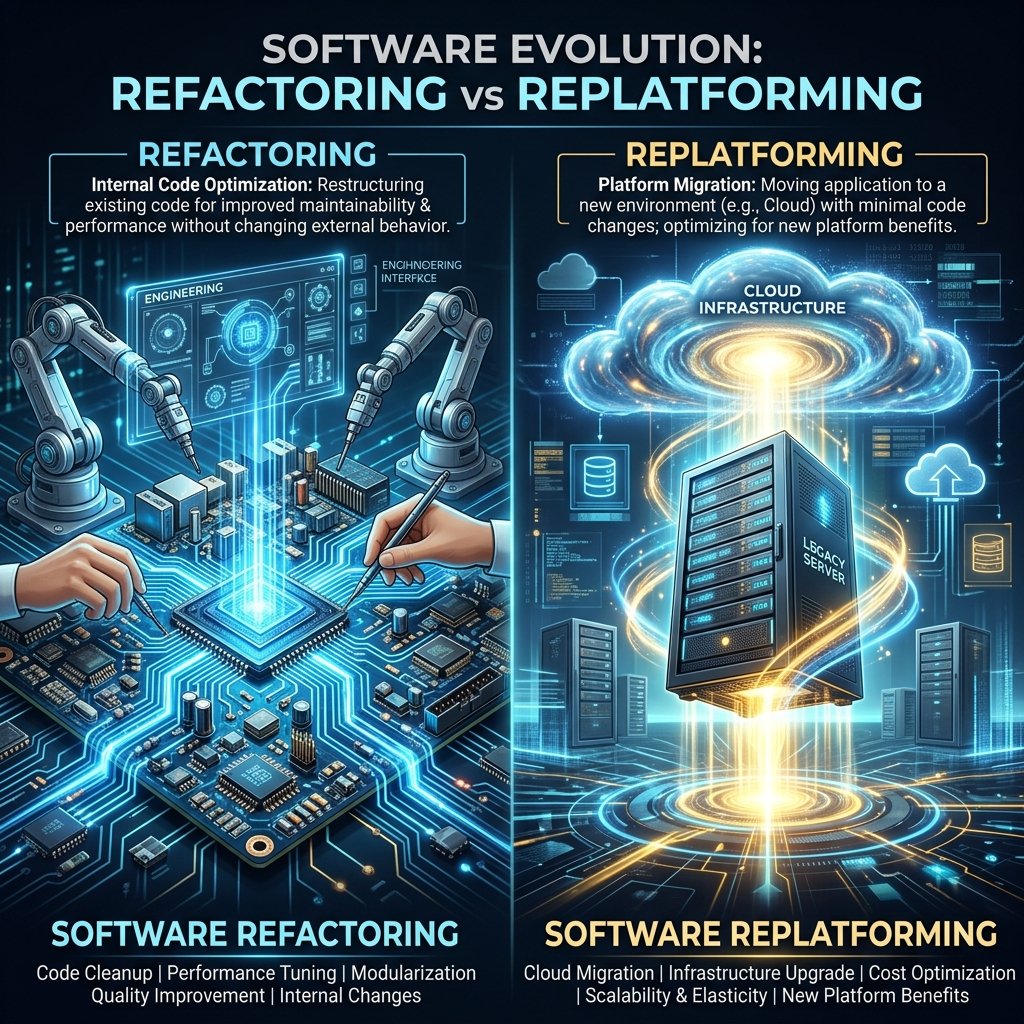
Refactoring vs. Replatforming: Choosing the Right Path for Legacy Apps
"A strategic comparison of refactoring and replatforming methodologies for legacy application modernisation, focusing on ROI, architectural integrity, and time-to-market."
Refactoring vs. Replatforming: Choosing the Right Path for Legacy Apps
In the pursuit of Digital Core Modernisation, enterprises are frequently faced with a critical crossroads: how to handle the legacy applications that form the backbone of their operations. The debate usually settles between two primary strategies: Refactoring and Replatforming. While both aim to move applications to the cloud and improve performance, their impact on cost, risk, and long-term agility varies significantly. Choosing the wrong path can lead to wasted budgets or, worse, a modernisation effort that fails to deliver business value.
"The difference between refactoring and replatforming is the difference between a total engine overhaul and putting a high-performance body kit on an old car. Both have their place, but only one changes the fundamental physics of the vehicle." — TAPOSYS Architectural Insight
Deconstructing the Modernisation Methodologies
Understanding the technical nuances of each approach is essential for making an informed architectural decision.
1. Replatforming: The 'Lift and Reshape' Approach
Replatforming involves making minimal changes to the application code while moving it to a modern cloud platform. The goal is to take advantage of cloud-native features (like managed databases or auto-scaling) without a full rewrite.2. Refactoring: The 'Architectural Re-imagining'
Refactoring is the process of significantly changing the application's internal structure and code to align with cloud-native principles. This often involves breaking a monolith into microservices or transitioning to serverless functions.3. The Decision Matrix: Which Path to Choose?
At TAPOSYS, we use a weighted decision matrix to guide our clients toward the most effective modernisation strategy.| Factor | Replatforming | Refactoring | | :--- | :--- | :--- | | Primary Goal | Infrastructure cost savings | Architectural agility & scalability | | Risk Level | Low to Moderate | High (requires cultural shift) | | Timeframe | Weeks to Months | Months to Years | | Skill Requirement | Cloud Ops proficiency | Deep Engineering & Domain expertise | | Legacy Debt | Partially addressed | Systematically eliminated |
"If the application is a 'black box' that works but is expensive to run, replatform. If the application is a bottleneck for new business features, you must refactor."
Executive Modernisation Checklist
The TAPOSYS Perspective: A Balanced Hybrid Approach
At TAPOSYS Global IT Solutions LLP, we often recommend a hybrid approach to Application Management (AMS). For many enterprises, the most effective strategy is to replatform the bulk of their portfolio for immediate efficiency gains, while refactoring the high-value, high-impact systems that drive core business innovation. By combining Cloud Engineering with a deep understanding of legacy architectures, we ensure that your modernisation journey is both pragmatic and transformative.Key Takeaway
Modernisation is not a binary choice. Replatforming offers quick wins and operational relief, while refactoring builds the foundation for long-term digital leadership. The key is to align the technical strategy with the business objective—choosing the path that offers the best balance of risk, reward, and responsiveness to market change.--- Uncertain about your modernisation roadmap? Consult with the experts at TAPOSYS Global to find the right architectural path for your legacy applications.

The TAPOSYS Perspective
Our architecture-first methodology ensures that every digital transformation initiative is rooted in absolute scalability and long-term security. We don't just build systems; we engineer future-proof legacies.