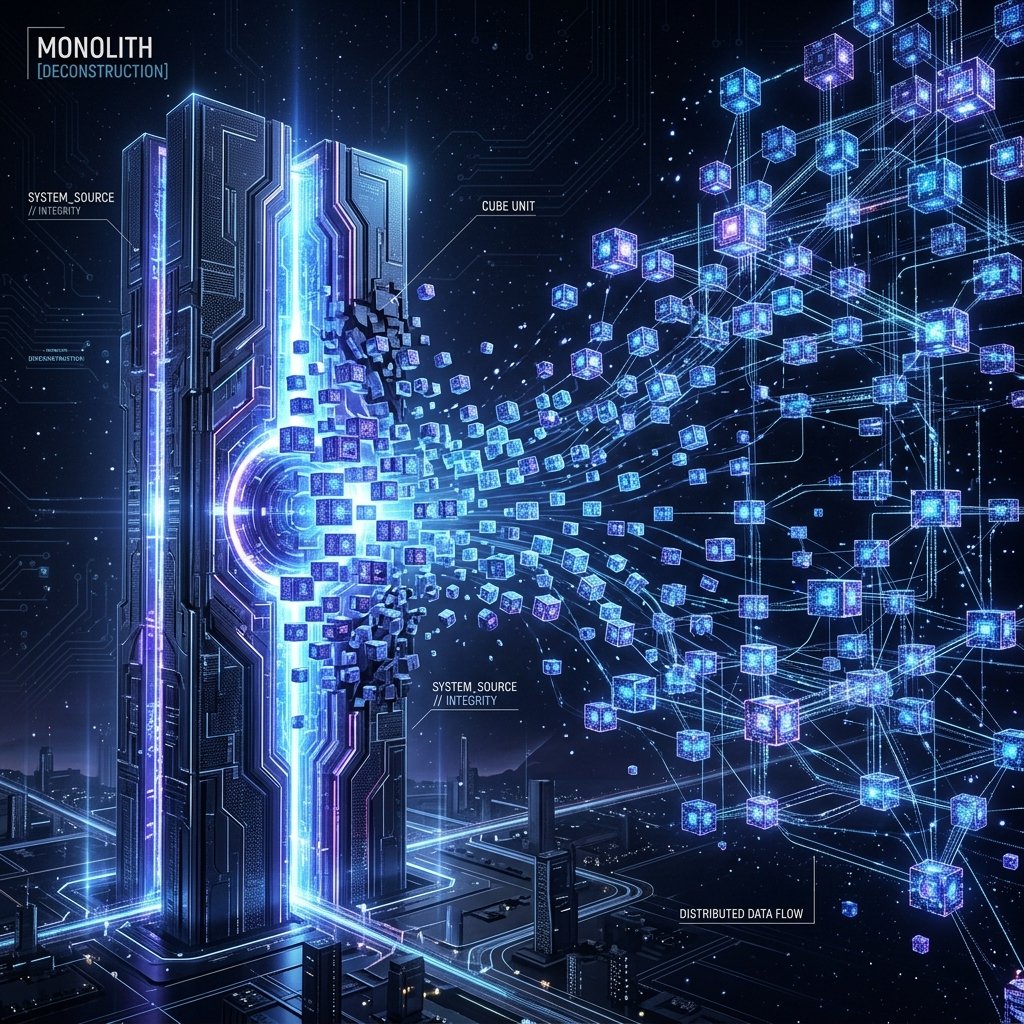
Monolith to Microservices: A Step-by-Step Modernisation Guide
"An architectural blueprint for deconstructing enterprise monoliths into scalable microservices, focusing on incremental migration and operational stability."
Monolith to Microservices: A Step-by-Step Modernisation Guide
In the landscape of enterprise software, the 'Monolith' is often viewed as a relic of a bygone era. Yet, these massive, unified codebases still power the majority of global business logic. The challenge for the modern Lead Architect is not just to replace them, but to systematically deconstruct them into a distributed ecosystem of Microservices. This transition is the cornerstone of Application Modernisation (AMS), enabling independent scalability, faster deployment cycles, and improved fault tolerance.
"The transition from monolith to microservices is not merely a change in deployment; it is a fundamental shift in how teams own, build, and operate software. It is the architectural equivalent of moving from a single, massive engine to a fleet of precision-engineered drones." — TAPOSYS Architectural Insight
The Strategic Blueprint for Deconstruction
Modernising a legacy monolith requires more than just code changes; it requires a phased approach that ensures business continuity while building a future-proof foundation.
1. The Domain Discovery Phase
Before a single line of code is moved, you must map the business domains. Using Domain-Driven Design (DDD), identify 'Bounded Contexts'—areas where specific business logic is self-contained. This prevents the 'Distributed Monolith' antipattern, where services are technically separate but logically entangled.2. Implementing the Strangler Fig Pattern
The most reliable way to migrate is the Strangler Fig Pattern. Instead of a risky 'big bang' rewrite, you incrementally replace functional pieces of the monolith with new microservices.3. Decoupling the Data Layer
This is the most complex step. Microservices mandate Database-per-Service to ensure true independence. Sharing a single database across services creates a 'Data Monolith' that limits scalability."Data decoupling is the point of no return. Once the state is distributed, the architecture must transition from synchronous calls to asynchronous events to maintain performance at scale."
4. Operationalising the Distributed System
As the number of services grows, manual management becomes impossible. This is where Cloud Engineering and AIOps become critical pillars of your strategy.Executive Modernisation Checklist
The TAPOSYS Perspective: Engineered Scalability
At TAPOSYS Global IT Solutions LLP, we specialise in the 'A-Z' of digital transformation. We understand that moving to microservices is a high-stakes operation. Our methodology combines deep architectural expertise with proactive Infrastructure Management (IMS) to ensure your transition is stable, secure, and ready for the next decade of innovation. We don't just split code; we engineer systems that empower your business to innovate at the speed of the market.Key Takeaway
Deconstructing a monolith is an iterative process of decoupling logic, data, and teams. Success is measured not by how fast you move, but by the stability and scalability of the resulting distributed system. By following the Strangler Fig pattern and prioritising data independence, enterprises can mitigate risk while achieving true architectural agility.--- Looking to modernise your legacy stack? Explore our Application Management and Cloud Engineering services at TAPOSYS Global.

The TAPOSYS Perspective
Our architecture-first methodology ensures that every digital transformation initiative is rooted in absolute scalability and long-term security. We don't just build systems; we engineer future-proof legacies.